Cold-Wash Laundry Formulation: Matching Enzymes to the Stain Profile
For detergent makers building cold-wash laundry products: match protease, amylase and lipase to the stains you claim, add them safely in liquids and powders, and validate before launch.
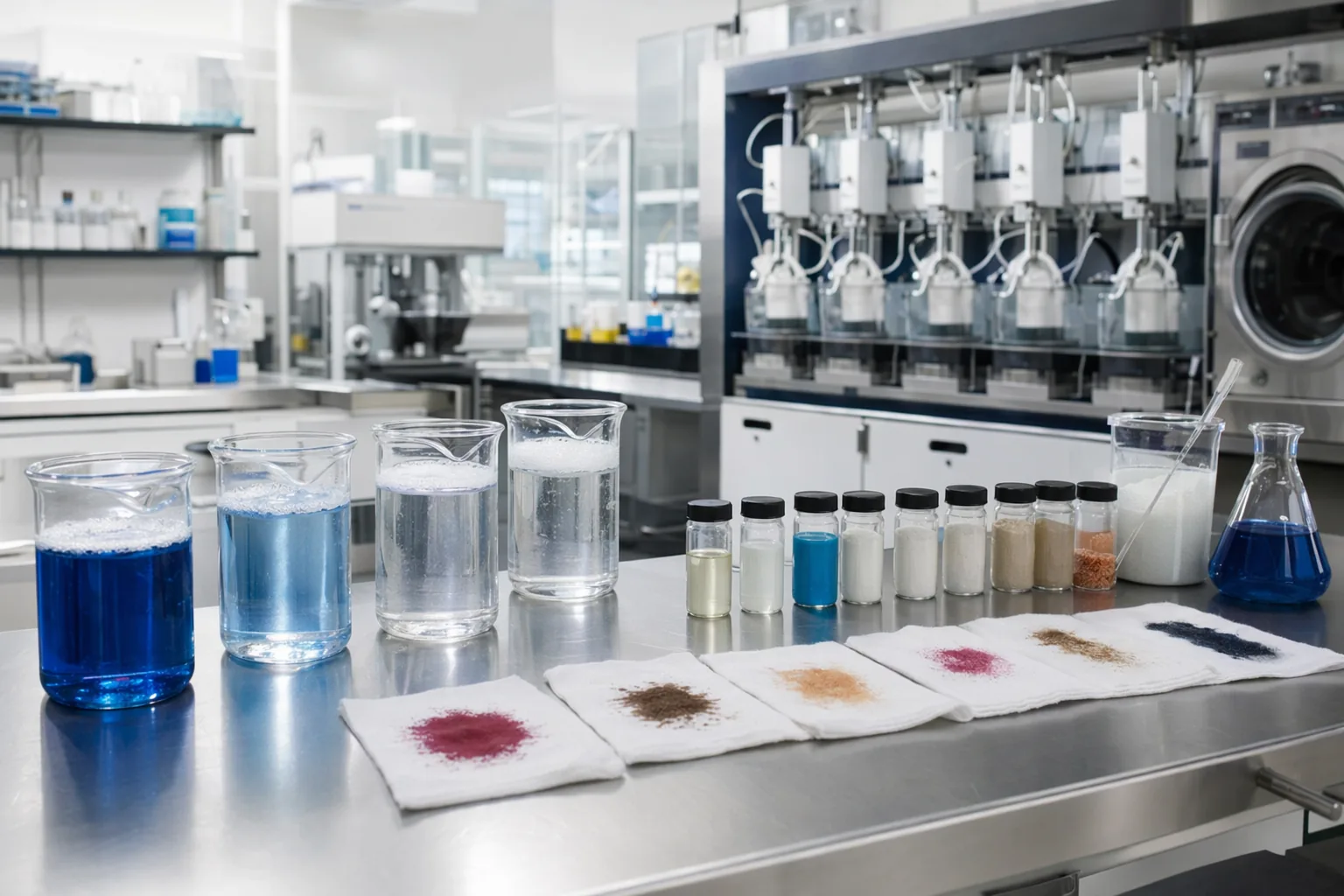
A cold-wash laundry product is only as good as its stain claims, and in an unheated wash those claims rest on the enzyme system. This guide is for formulators and buyers at detergent manufacturers and private-label brands: how to match enzymes to the stain profile, where to add them in liquid and powder production, and how to validate before launch.
FastEnzyme supplies a cold-active protease, lipase and amylase system (optimal pH 8.0–11.0, 15°C–60°C) as granules or powder. Request a quote with the product, quantity and destination.
Why the Enzyme System Carries a Cold-Wash Formula
When laundry is washed cold instead of hot, conventional detergent chemistry loses cleaning speed, especially on protein, starch, fat and mixed food soils. Cold-active enzymes keep catalytic activity at lower wash temperatures, so the formula depends less on heat. For a detergent manufacturer the value is not enzyme activity alone but fit with the whole formula: anionic and nonionic surfactants, chelants, builders, optical brighteners, anti-redeposition polymers, fragrances, preservatives and process conditions. Compare candidates by real wash testing, not by activity units on a data sheet.
Built for cold-water laundry positioning • Protein, starch and fat stain removal depending on enzyme class • Needs formulation compatibility and pilot validation before scale-up
Choose the Right Enzyme System for the Stain Profile
A cold-wash detergent usually needs a blend rather than a single enzyme. Protease targets blood, egg, dairy and grass-related protein soils. Amylase removes starch-based soils such as sauces, baby food and rice residues. Lipase supports removal of fats and oily food stains, and needs a careful fragrance and odor check. Ask your supplier for activity profiles across the pH and temperature range of your product, and do not select on headline activity alone: the enzyme must survive the finished product and still clean after storage.
Protease: protein stains • Amylase: starch soils • Lipase: fats and oils
Formulation Conditions: pH, Temperature and Dose
Define two sets of conditions before formulation work starts: the wash conditions your customers use and the in-pack storage conditions. Detergent enzymes of this type perform best in alkaline systems; this product's optimal window is pH 8.0–11.0 and 15°C–60°C, so screen within your own formula's pH and at the wash temperatures you claim. There is no single correct dose: start from the supplier's TDS guidance, trial a small range of inclusion levels and normalize by activity and cost-in-use. Liquids need attention to water activity, preservatives, polyols, calcium, stabilizer systems and surfactant compatibility. Powders need intact granule coating, dust control, low segregation and moisture protection. Set the final dose from stain-panel results after storage, not fresh-mix performance alone.
Screen at the wash temperatures you claim • Stay within your formula's pH and the TDS window • Evaluate fresh and aged detergent • Normalize dosage by activity and cost-in-use
Processing and Addition Points in Liquid and Powder Detergents
Avoid enzyme losses during manufacturing. In liquid detergents, enzymes are commonly added late in the batch after high-shear surfactant incorporation, pH adjustment, and cooling. A typical safe addition window is below 35–40°C, provided the supplier TDS supports that temperature. Avoid local pH shocks by pre-diluting alkaline or acidic adjusters and confirming uniform mixing before enzyme addition. In powder detergents, granulated enzymes should be blended after aggressive spray-drying or high-temperature steps, using low-dust handling and appropriate worker exposure controls described in the SDS. For capsules or unit-dose products, check enzyme compatibility with concentrated surfactant systems and film moisture. Across formats, record enzyme lot, activity, addition time, batch temperature, pH, and mixing duration for traceability and troubleshooting.
Add enzymes late in liquid processing when possible • Avoid hot spots, pH shocks, and excessive shear • Use SDS guidance for dust and aerosol exposure control • Record lot and process data for batch traceability
QC, Stability Testing, and Pilot Validation
Your supplier should support QC methods that connect enzyme activity to finished-detergent performance. Incoming QC typically reviews COA activity, appearance, odor, density or granule size, microbiological limits where relevant, and batch traceability. Finished-product QC should track pH, viscosity, phase stability, moisture, preservative status, enzyme activity retention, and wash performance. Stability programs cover several storage temperatures that match your distribution, plus freeze-thaw testing for liquids where distribution requires it. Run stain-panel tests after aging, not only at time zero, using local water hardness and consumer-relevant wash cycles. A pilot batch should confirm that the detergent concept remains stable under real mixing, filling, packing, warehousing, and transport conditions before commercial launch.
Check COA against internal incoming specifications • Measure activity retention after storage • Use local water hardness in wash testing • Validate pilot-scale mixing, filling, and packaging
Supplier Qualification and Cost-in-Use Evaluation
A cold-active enzyme supplier should be evaluated on technical fit, supply reliability, documentation, and commercial support. Request the TDS for recommended pH, temperature, activity method, stabilizers, dosage guidance, and formulation cautions. The SDS should define safe handling, respiratory sensitization controls, spill response, storage, and transport requirements. The COA should provide batch-specific activity and quality attributes, not only product identity. During qualification, compare candidate enzymes by cost-in-use: dosage needed to reach a defined wash result after storage, not price per kilogram alone. Also review lead times, batch-to-batch consistency, packaging options, shelf life, change-notification practices, and regulatory documentation relevant to your sales regions. A strong supplier helps with pilot validation and troubleshooting without making unsupported performance claims.
Request COA, TDS, SDS, and batch traceability • Compare cost-in-use after aging and wash testing • Confirm lead time, shelf life, and change-notification process • Qualify suppliers before commercial scale-up
To request a quote, send the product, the quantity in kg, the destination country and your detergent format. Prices are quoted per order.
Technical Buying Checklist
Bring these points to the supplier call or put them in your inquiry.
Stain claims on the pack and the matching enzyme classes • Detergent format and addition point in your process • Formula pH and the TDS window (this product: pH 8.0–11.0, 15°C–60°C) • Granules or powder for your line • COA, TDS and SDS for the exact grade • Stability plan for your storage and distribution • 25 kg fiber drums or custom packaging; MOQ 25 kg • Quantity in kg and destination country for the quote
Cold-Active Detergent Enzymes for Research & Industry
Need Cold-Active Detergent Enzymes for your lab or production process?
ISO 9001 certified · Food-grade & research-grade · Ships to 80+ countries
Frequently Asked Questions
What does a cold-wash detergent enzyme system need to do?
It has to keep useful activity at the lower wash temperatures your customers use. Depending on the enzyme class, it breaks down protein, starch or fat stains in cold water. Evaluate activity profile, pH stability, in-pack stability, surfactant compatibility and aged wash performance before you set a commercial dose.
What dosage should I use for cold-active detergent enzymes?
Start from the supplier's TDS guidance and trial a small range of inclusion levels in your own base; the final level should rest on activity and wash results. Test fresh and aged detergent at the intended wash temperature, pH, water hardness and soil load. The best dose is the lowest level that meets your targets with acceptable stability and cost-in-use.
Are cold-active enzymes compatible with alkaline detergents?
Many detergent enzymes are designed for mildly alkaline laundry systems, but tolerance varies by enzyme type and supplier product. Screen candidates at the formulation’s target pH (this product's optimal window is pH 8.0–11.0) and test stability after storage. Compatibility should include surfactants, builders, chelants, polymers, preservatives, fragrance, dyes, and any encapsulation system. Always confirm recommended operating limits in the supplier TDS.
How should enzyme performance be validated for cold water detergent?
Combine analytical QC with application testing. Measure enzyme activity retention, pH, viscosity or powder flow, appearance, odor and phase stability after storage. Then run stain-panel wash tests at the temperatures you claim, with relevant water hardness and wash cycles. Compare against a control formula and calculate cost-in-use after aging, not only at time zero.
What documents should a cold wash detergent enzyme supplier provide?
A qualified supplier should provide a COA for batch-specific quality, a TDS with activity method and formulation guidance, and an SDS covering safe handling and exposure controls. Buyers may also request shelf-life data, storage recommendations, packaging options, allergen-handling guidance, batch traceability, regulatory support for target markets, and a change-notification process. These documents help support supplier qualification and manufacturing control.
Related: Low-Temperature Cleaning with a Cold-Active Enzyme System
Turn This Guide Into a Supplier Brief Contact FastEnzyme to discuss cold-active detergent enzyme selection, samples, and pilot validation for your cold water detergent formula. See our application page for Cold-Active Detergent Enzymes for Low-Temperature Cleaning at /applications/cold-temperature-enzyme-activity/ for specs, MOQ, and a free 50 g sample.
Contact Us to Contributehello@mail.fastenzyme.com