Low Temperature Enzyme Supplier for Cold Water Detergent
Source cold-active detergent enzymes for cold water detergent. Review pH, dose, QC, pilot trials, COA/TDS/SDS, and cost-in-use.
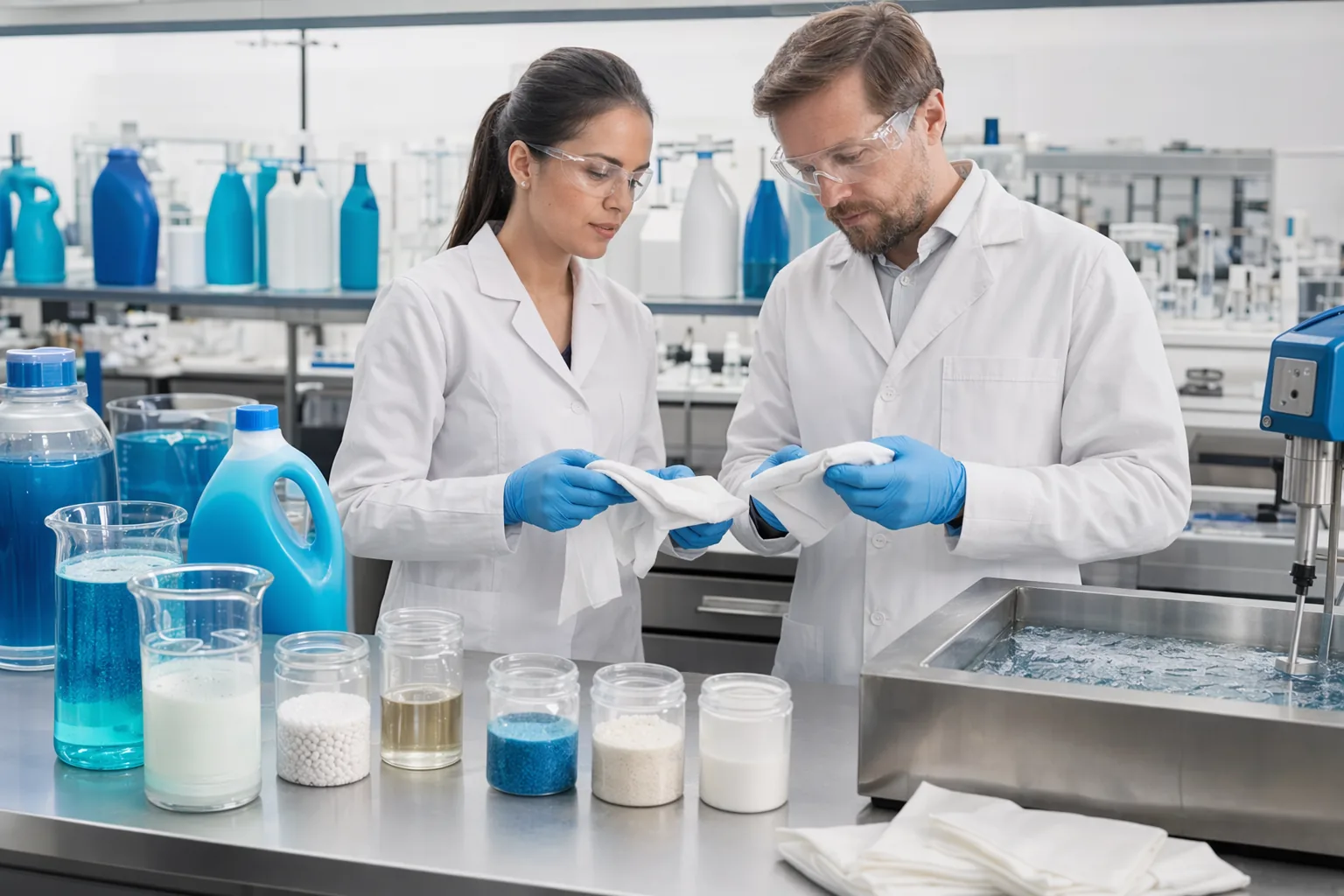
Fastenzyme.com supports detergent manufacturers seeking cold-active enzyme systems for cold water detergent and energy-saving laundry formats.
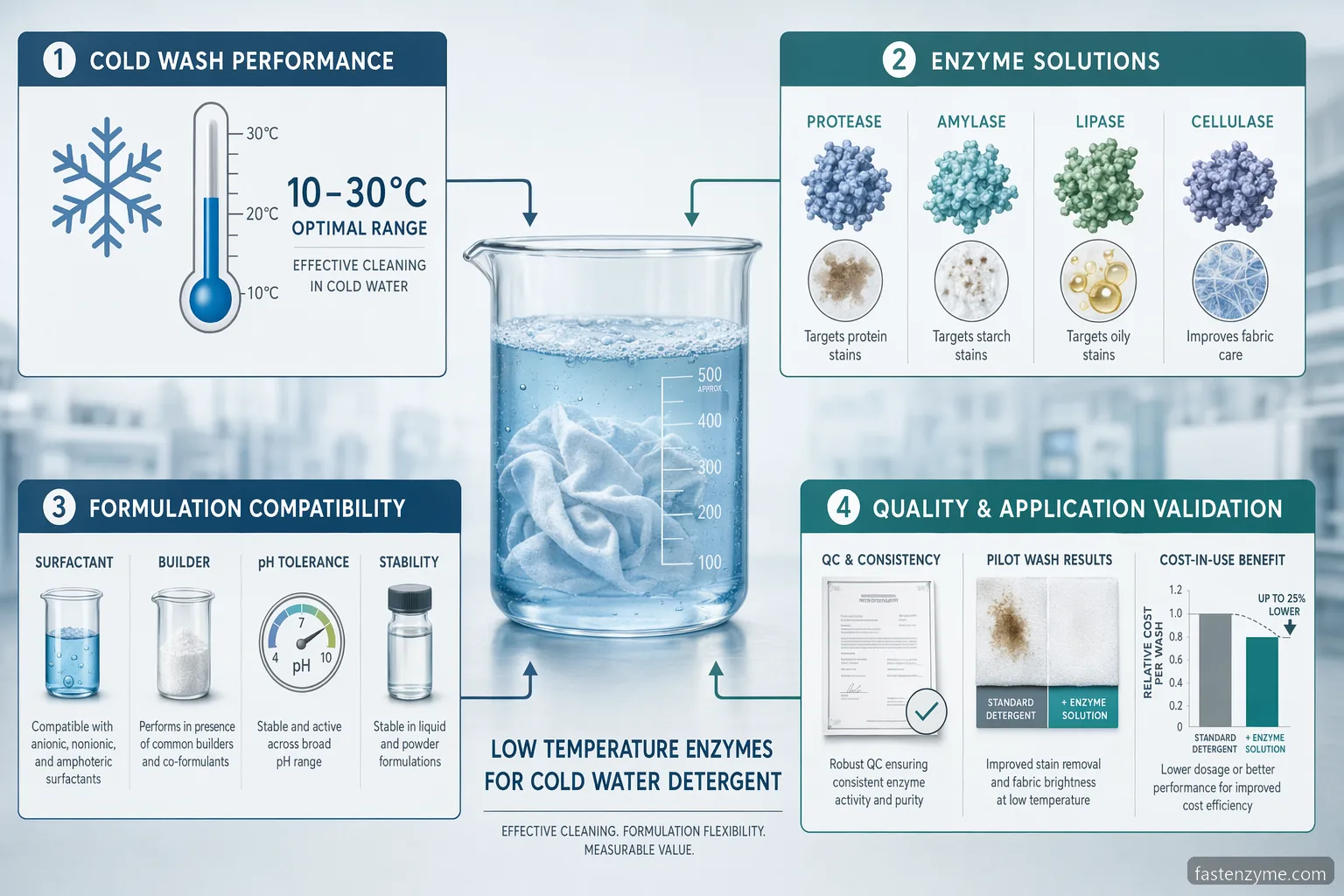
Why cold-active enzymes matter in modern detergents
Cold water detergent is designed to reduce wash energy while maintaining acceptable cleaning on protein, starch, fat, and particulate soils. A low temperature enzyme for cold water detergent must deliver useful catalytic activity when conventional enzymes slow down, especially in short consumer wash cycles. For B2B detergent producers, this is not only a performance topic; it affects dosage cost, formulation claims, stability planning, and product positioning for energy-saving laundry. Fastenzyme.com supplies cold wash detergent enzyme options for manufacturers developing liquid laundry, powder detergent, unit-dose, and institutional products. Cold-active enzyme selection should be driven by the target stains, local wash habits, water hardness, surfactant chemistry, and storage conditions. A psychrophilic enzyme or engineered cold active enzyme may show higher activity at low temperature, but each candidate still requires formulation-specific validation before commercialization.
Target applications include cold water detergent and energy-saving laundry. • Useful enzyme classes include protease, amylase, lipase, cellulase, and blended systems. • Performance should be confirmed in the buyer’s own detergent matrix.
Typical process conditions for cold water detergent trials
When screening an industrial low temperature enzyme cold water detergent project, start with practical laboratory conditions that resemble consumer use. Common cold wash evaluations run at 5–30°C, with many formulators emphasizing 15–25°C for routine comparison. Laundry detergent systems often operate near pH 7.5–10.5, depending on liquid, powder, or institutional format. Initial dosage can be screened across a broad band, such as 0.05–0.50% enzyme preparation in finished detergent, or by activity units per wash dose when the TDS provides a reliable assay. Use standard soiled swatches, controlled water hardness, fixed liquor ratio, and defined wash time. The best low temperature enzyme supplier for cold water detergent should help translate lab activity into finished-product performance, not only provide a nominal enzyme concentration.
Screen at 5, 15, 25, and 30°C where relevant. • Check pH stability in the actual detergent base. • Record dosage as both weight percent and activity units when possible.
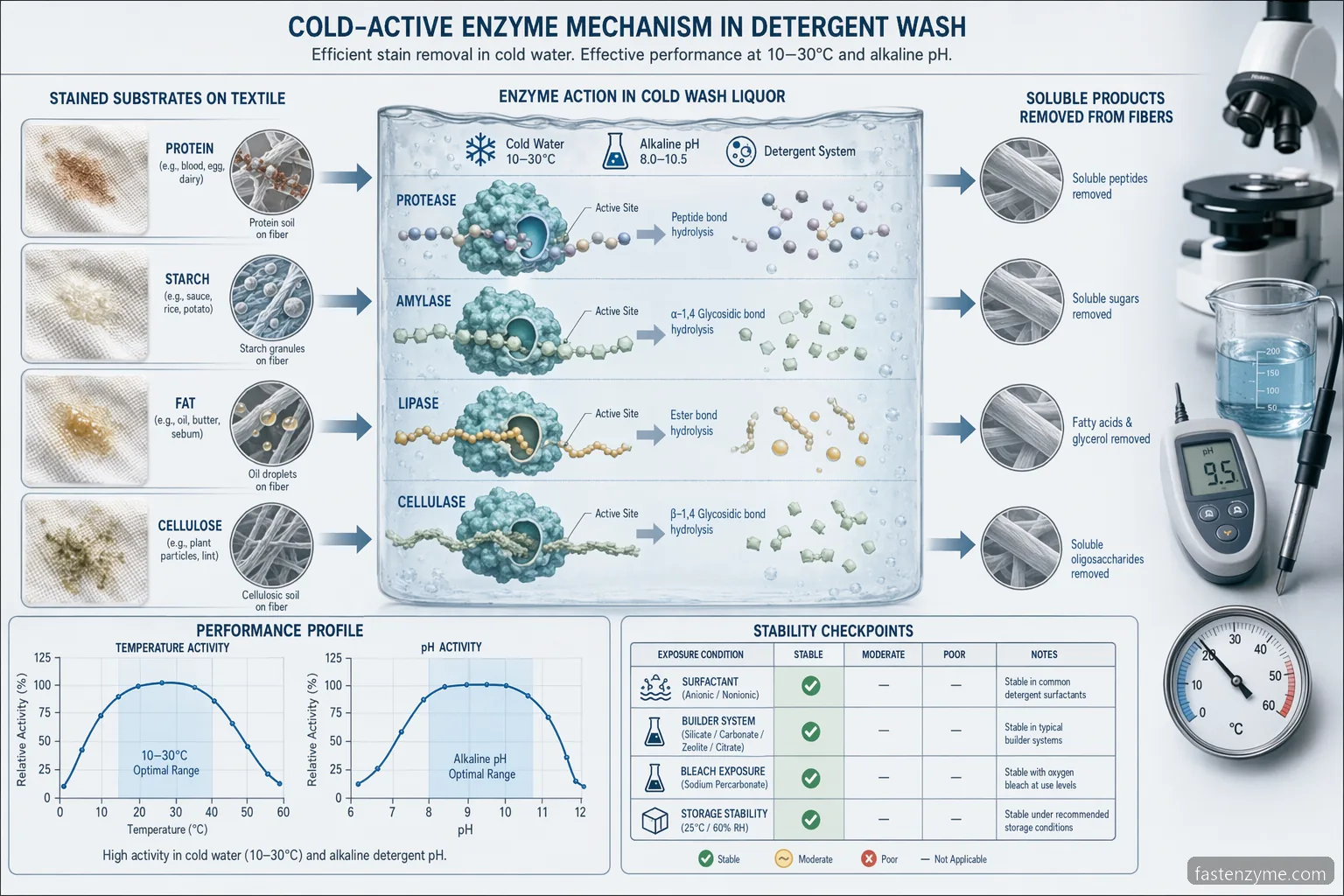
Choosing the right enzyme class for cold wash performance
A cold wash detergent enzyme for cold water detergent should match the soil challenge. Cold-active protease targets blood, dairy, egg, grass, and other proteinaceous stains. Amylase supports removal of starch-based foods such as rice, pasta, sauces, and baby food. Lipase helps with sebum, oils, butter, and fatty soils, though performance can be strongly affected by surfactant type and wash time. Cellulase can contribute to fabric appearance, particulate soil release, and anti-pilling benefits in selected formulations. Many commercial detergents use a multi-enzyme approach, but more enzymes do not automatically mean better cost-in-use. Interactions among enzymes, surfactants, builders, solvents, preservatives, and bleaching systems can alter stability. For an industrial cold active enzyme cold water detergent program, request single-enzyme samples and blend options so your technical team can compare performance, compatibility, and economics.
Protease: protein stains. • Amylase: starch soils. • Lipase: fat and sebum soils. • Cellulase: fabric care and particulate soil release.
Formulation compatibility and stability checkpoints
Cold active enzyme supplier for cold water detergent projects should include compatibility review before scale-up. Liquid detergents may expose enzymes to high surfactant levels, solvents, preservatives, chelants, and variable water activity. Powder detergents require attention to granule protection, dust control, moisture, and potential contact with alkaline builders or oxidizing ingredients. Enzymes are proteins, so stability can decline under unsuitable pH, high temperature storage, aggressive surfactants, or incompatible preservatives. Practical checks include enzyme activity retention after accelerated storage, visual appearance, odor, viscosity change, phase separation, and stain removal after storage. Typical accelerated studies may include 25°C, 35°C, and 40°C intervals, with timepoints such as 2, 4, 8, and 12 weeks, depending on product target. Final shelf-life decisions should be supported by real-time storage data.
Test the enzyme in the complete detergent formula. • Monitor activity retention and cleaning performance. • Evaluate accelerated and real-time storage data.
QC documents buyers should request
For supplier qualification, industrial buyers should request a current COA, TDS, and SDS for each low temperature enzyme candidate. The COA should identify batch number, activity result, test method reference, appearance, and relevant release specifications. The TDS should describe recommended application, activity definition, handling guidance, pH and temperature profile, storage conditions, and typical dosage range. The SDS should support safe industrial handling, including respiratory sensitization precautions that apply to enzyme proteins. Buyers may also request allergen handling statements, non-confidential manufacturing information, sample traceability, and change notification practices where appropriate. Avoid relying on unverifiable claims. Instead, qualify a cold wash detergent enzyme supplier for cold water detergent by comparing documentation quality, batch consistency, technical responsiveness, and the supplier’s ability to support pilot validation.
COA: batch-specific release data. • TDS: application and technical guidance. • SDS: safe handling and storage information. • Retain samples: support traceability and dispute review.
Pilot validation and cost-in-use analysis
Pilot validation bridges laboratory screening and commercial production. After selecting one or two low temperature enzyme candidates, run pilot batches using the intended mixing order, processing temperature, hold time, packaging, and storage plan. Confirm that enzyme addition does not create unacceptable foaming, viscosity drift, haze, sediment, odor, or activity loss. Performance should be tested against a control detergent at the same wash dose and cold wash settings. Cost-in-use should include enzyme price, activity strength, recommended dosage, stain removal improvement, formulation savings, rework risk, storage loss, and logistics. The cheapest drum price is not always the lowest cost in finished detergent. A reliable low temperature enzyme supplier for cold water detergent should support sample evaluation, technical discussion, and scale-up planning with realistic data.
Compare performance per wash, not only price per kilogram. • Run pilot batches before commercial purchase commitments. • Confirm mixing order and storage stability at production scale.
Technical Buying Checklist
Buyer Questions
It is an industrial detergent enzyme selected to provide useful catalytic activity at cold wash temperatures, often between 5°C and 30°C. Depending on the enzyme class, it can help break down protein, starch, fat, or cellulose-related soils. Performance must be verified in the finished detergent formula because surfactants, pH, water hardness, preservatives, and storage conditions can change results.
Start with the supplier’s TDS and screen several levels, such as 0.05–0.50% enzyme preparation in finished detergent, or activity units per wash dose. The correct dose depends on enzyme activity, detergent format, wash temperature, target stain, and stability after storage. Final dosage should be chosen by cost-in-use and cleaning performance, not by enzyme percentage alone.
A qualified supplier should provide a COA for the supplied batch, a TDS with application guidance, and an SDS for safe industrial handling. Buyers should also request the activity assay method, storage recommendations, shelf-life guidance, sample traceability, and any relevant change notification process. These documents support incoming QC, pilot validation, and procurement review.
Yes, but the formulation strategy differs. Liquid detergents require attention to surfactant, solvent, preservative, pH, and water activity compatibility. Powder detergents require attention to granule protection, moisture, alkalinity, dust control, and contact with oxidizing ingredients. In both formats, run stability and stain-removal testing after storage before making commercial claims.
Compare suppliers using technical documentation, batch consistency, sample responsiveness, application support, pilot-scale performance, supply reliability, and cost-in-use. Avoid selecting only by quoted price per kilogram. A stronger enzyme may dose lower, store better, or improve cleaning performance enough to reduce total formulation cost and production risk.
Related Search Themes
low temperature enzyme for cold water detergent, industrial low temperature enzyme cold water detergent, cold wash detergent enzyme supplier for cold water detergent, cold active enzyme supplier for cold water detergent, industrial cold wash detergent enzyme cold water detergent, industrial cold active enzyme cold water detergent
Cold-Active Detergent Enzymes for Research & Industry
Need Cold-Active Detergent Enzymes for your lab or production process?
ISO 9001 certified · Food-grade & research-grade · Ships to 80+ countries
Frequently Asked Questions
What is a low temperature enzyme for cold water detergent?
It is an industrial detergent enzyme selected to provide useful catalytic activity at cold wash temperatures, often between 5°C and 30°C. Depending on the enzyme class, it can help break down protein, starch, fat, or cellulose-related soils. Performance must be verified in the finished detergent formula because surfactants, pH, water hardness, preservatives, and storage conditions can change results.
How should we dose a cold wash detergent enzyme?
Start with the supplier’s TDS and screen several levels, such as 0.05–0.50% enzyme preparation in finished detergent, or activity units per wash dose. The correct dose depends on enzyme activity, detergent format, wash temperature, target stain, and stability after storage. Final dosage should be chosen by cost-in-use and cleaning performance, not by enzyme percentage alone.
What documents should a cold active enzyme supplier provide?
A qualified supplier should provide a COA for the supplied batch, a TDS with application guidance, and an SDS for safe industrial handling. Buyers should also request the activity assay method, storage recommendations, shelf-life guidance, sample traceability, and any relevant change notification process. These documents support incoming QC, pilot validation, and procurement review.
Can cold-active enzymes be used in liquid and powder detergents?
Yes, but the formulation strategy differs. Liquid detergents require attention to surfactant, solvent, preservative, pH, and water activity compatibility. Powder detergents require attention to granule protection, moisture, alkalinity, dust control, and contact with oxidizing ingredients. In both formats, run stability and stain-removal testing after storage before making commercial claims.
How do we compare enzyme suppliers for cold water detergent?
Compare suppliers using technical documentation, batch consistency, sample responsiveness, application support, pilot-scale performance, supply reliability, and cost-in-use. Avoid selecting only by quoted price per kilogram. A stronger enzyme may dose lower, store better, or improve cleaning performance enough to reduce total formulation cost and production risk.
Related: Cold-Active Detergent Enzymes for Low-Temperature Cleaning
Turn This Guide Into a Supplier Brief Contact Fastenzyme.com for cold-active detergent enzyme samples, COA/TDS/SDS review, and pilot validation support. See our application page for Cold-Active Detergent Enzymes for Low-Temperature Cleaning at /applications/cold-temperature-enzyme-activity/ for specs, MOQ, and a free 50 g sample.
Contact Us to Contribute