Substrate For Production Cold Active Enzymes: Cold-Active Detergent Enzymes Supplier Guide
Source cold-active detergent enzymes for cold-water laundry. Review substrates, specs, dosage, COA/TDS/SDS, pilot validation, and cost-in-use.
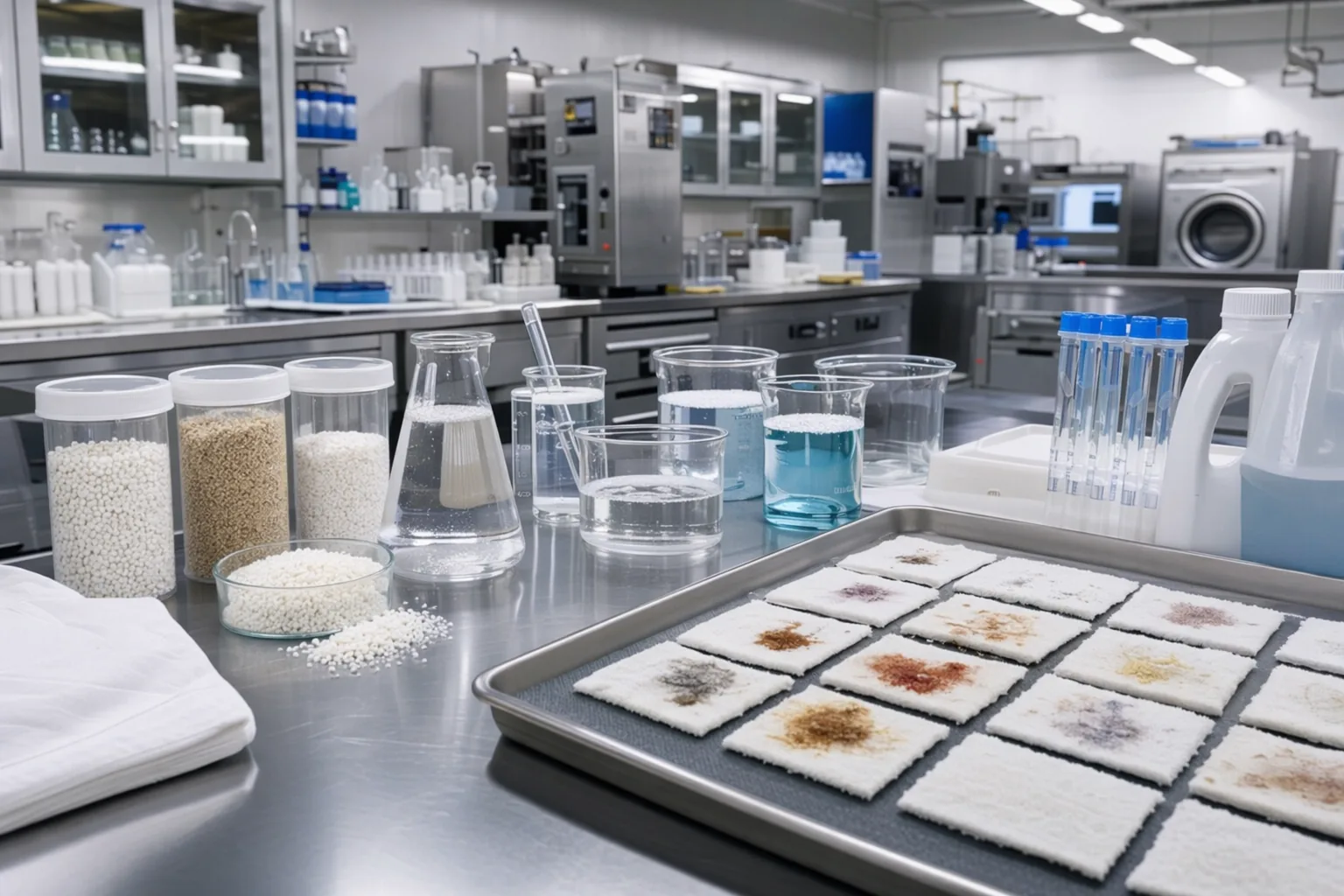
For detergent manufacturers moving to cold-water and energy-saving laundry formulas, the right cold active enzymes and the right production substrate strategy can improve stain removal, stability, and cost-in-use.
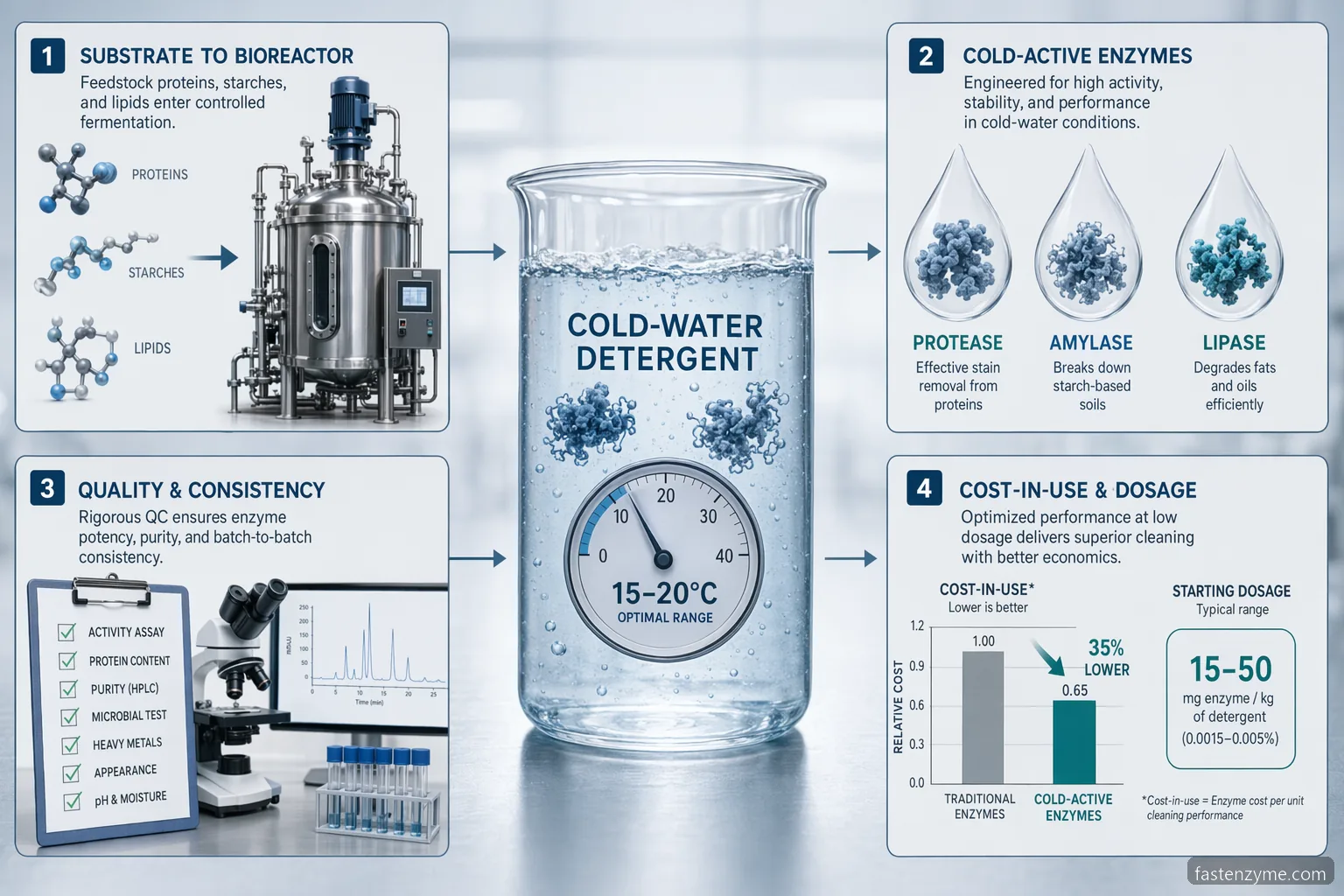
Why substrate selection matters for cold-active enzyme supply
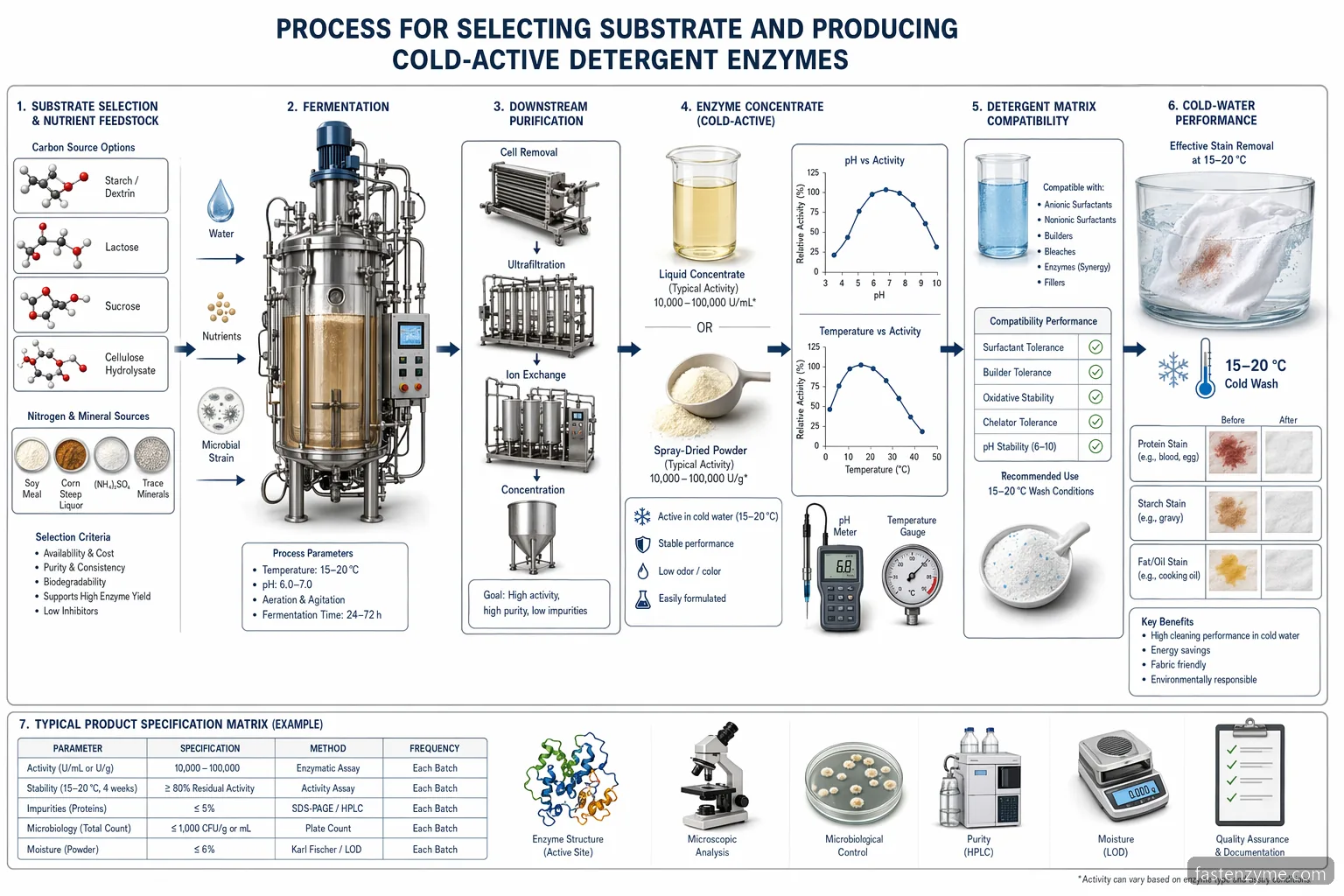
For a B2B detergent buyer, the phrase substrate for production cold active enzymes is not just a fermentation detail. It affects batch yield, enzyme spectrum, residual impurities, production economics, and reproducibility. Cold-active enzymes are commonly produced by selected microbial strains, including psychrophilic or psychrotolerant organisms, under controlled fermentation. The carbon and nitrogen sources used in that process can influence protease, amylase, lipase, cellulase, or multi-enzyme expression. Agro-residue options, such as substrate with mandarin peel for production cold active enzymes, may be evaluated as fruit-derived carbon sources after appropriate pretreatment, sterilization, and contaminant control. However, buyers should avoid choosing a supplier only because a feedstock sounds sustainable. The commercial question is whether the resulting cold active enzymes substrate strategy delivers consistent detergent performance, stable activity, safe handling, and reliable cost-in-use across lots.
Assess substrate traceability and consistency. • Confirm pretreatment and contamination controls. • Review batch-to-batch activity variation. • Link fermentation inputs to finished enzyme specifications.
Cold-water detergent performance requirements
Cold wash detergent enzyme systems must work in realistic laundry conditions, not only in a laboratory assay. Typical cold-water programs run at 10-30°C, while detergent wash pH often falls between pH 8.0 and 10.5. A robust cold active enzyme or cold active enzymes complex should retain useful activity in the presence of builders, surfactants, chelants, optical brighteners, fragrance components, and sometimes oxidants. For laundry applications, buyers usually evaluate protease for protein stains, amylase for starch, lipase for fats and sebum, and cellulase for fabric care and soil release. A low temperature enzyme may show a higher initial reaction rate at 15-25°C than a standard mesophilic enzyme, but it also needs acceptable shelf stability in the finished detergent. The best supplier discussion combines enzyme kinetics, formulation compatibility, storage behavior, and practical wash test results.
Screen at 10°C, 15°C, 20°C, and 30°C. • Test in target wash pH, not only neutral pH. • Use local water hardness and target detergent base. • Compare stain panels against a no-enzyme control.
Product formats and starting dosage bands
Cold active detergent enzymes are typically supplied as coated granules for powder detergents, stabilized liquids for liquid detergents, or customized blends for unit-dose and industrial laundry products. Dosage must be based on declared activity units, formulation pH, expected shelf life, and required claim level. As a starting point, formulators often screen enzyme products in the range of 0.05-0.30% w/w of finished detergent, then narrow the level through wash trials and stability testing. For high-activity single enzymes, lower inclusion levels may be appropriate; for cold active multi enzymes, the dose should be adjusted by each enzyme activity rather than total mass alone. A cold wash detergent enzyme supplier should provide a TDS with recommended pH, temperature, activity assay, handling limits, and formulation guidance. Final dosage should always be fixed by pilot validation and cost-in-use analysis.
Powder detergent: evaluate coated, low-dust granules. • Liquid detergent: confirm preservative and surfactant compatibility. • Multi-enzyme blends: dose by individual activity contribution. • Confirm stability after accelerated and real-time storage.
QC documentation buyers should request
A qualified supplier should support each commercial lot with a Certificate of Analysis, Technical Data Sheet, and Safety Data Sheet. The COA should report enzyme activity using a defined method and substrate, because activity numbers are not comparable if assays differ. Depending on format, key QC items may include moisture, pH, appearance, bulk density, particle size, dust level, microbial limits, preservative level, and stability trend data. For a cold active enzymes complex substrate process, buyers should ask whether fermentation substrates or fruit-derived inputs create variable color, odor, ash, or residual sugar risks. SDS review is important for occupational handling, especially for enzyme dust or aerosols that may cause sensitization. A professional detergent enzyme supplier should also provide change notification procedures when strain, substrate, process, carrier, coating, or preservative systems are modified.
COA: activity, appearance, batch number, release date. • TDS: use level, pH range, temperature range, storage. • SDS: handling, PPE, spill response, sensitization warnings. • Change control: notification before process or raw material changes.
Pilot validation in cold water detergent
Pilot validation converts enzyme promise into production confidence. Start with bench screening in the exact detergent base, then move to pilot batches using normal mixing order, shear, temperature, and hold times. For cold water detergent, wash testing should include representative stains such as blood-milk-ink, egg, cocoa, starch, sebum, cooking oil, and particulate soil. Run tests at 15°C and 20°C, with a 30°C comparison, using controlled liquor ratio, fabric type, water hardness, and wash duration. Stability testing should cover the finished detergent at 25°C, 35°C, and 40°C where relevant, plus freeze-thaw for liquids if distribution requires it. Track activity retention, stain removal, odor, viscosity, phase separation, granule integrity, and package compatibility. The goal is not maximum enzyme activity in isolation, but reliable cleaning benefit per unit cost.
Use a no-enzyme and current-enzyme control. • Measure stain removal instrumentally where possible. • Check finished-product stability, not enzyme concentrate only. • Confirm scale-up mixing does not damage enzyme format.
Supplier qualification and cost-in-use
For industrial procurement, the lowest price per kilogram rarely identifies the best cold active enzymes supplier. Cost-in-use depends on activity concentration, required dosage, shelf-life loss, production handling, waste, freight, packaging, and performance at low temperature. Supplier qualification should review fermentation capability, substrate sourcing, contamination controls, allergen and sensitization handling practices, batch traceability, analytical capacity, and lead-time reliability. If a supplier promotes substrate with mandarin peel for cold active enzymes or any fruit substrate approach, request evidence that the feedstock is controlled, repeatable, and suitable for detergent enzyme production. Commercial agreements should include specifications, retain-sample policy, deviation handling, change control, and technical support for reformulation. A strong partner helps the buyer reduce wash temperature while maintaining cleaning performance, rather than selling enzyme activity units without application support.
Compare total delivered cost per effective wash. • Request pilot lots before locking specifications. • Review supply continuity and raw material risk. • Require technical support for formulation troubleshooting.
Technical Buying Checklist
Buyer Questions
There is no universal best substrate for production cold active enzymes. The right choice depends on the microbial strain, target enzyme type, fermentation yield, impurity profile, and final detergent performance. Buyers should evaluate whether the substrate supports consistent activity and quality at scale. Ask suppliers for batch data, substrate traceability, activity assay methods, and evidence that the finished enzyme performs in cold water detergent conditions.
Mandarin peel and other fruit residues can be studied as carbon-rich fermentation inputs after pretreatment, size control, sterilization, and contaminant management. For commercial detergent enzymes, the key issue is not the feedstock name but repeatability. If a supplier offers substrate with mandarin peel for cold active enzymes, request QC data, process controls, residual risk assessment, and pilot detergent performance before approval.
Cold active enzymes are selected to deliver useful catalytic activity at lower wash temperatures, typically 10-30°C. Standard detergent enzymes may still work at these temperatures, but often at slower rates. A cold active enzyme can help support energy-saving laundry claims when validated in the final detergent. Buyers should compare stain removal, storage stability, and cost-in-use rather than relying only on activity values from one assay.
Request a COA for each lot, a TDS with formulation guidance, and an SDS for safe handling. Also ask for activity assay methods, recommended dosage, pH and temperature range, storage conditions, compatibility data, and change control procedures. For a cold active enzymes complex with fruit substrate, request additional information on substrate sourcing, fermentation controls, and batch consistency.
Begin with bench testing in your detergent base at the intended pH and dose range. Then run wash trials at 15°C, 20°C, and 30°C using relevant stain panels, water hardness, fabrics, and wash times. Confirm finished-product stability under real-time and accelerated storage. Scale-up should verify mixing order, shear exposure, enzyme retention, package compatibility, and cost per effective wash.
Related Search Themes
substrate with mandarin peel for production cold active enzymes, substrate for production cold active multi enzymes, substrate with mandarin peel for cold active enzymes, substrate for cold active enzymes, cold active enzymes substrate, cold active enzymes complex with fruit substrate
Cold-Active Detergent Enzymes for Research & Industry
Need Cold-Active Detergent Enzymes for your lab or production process?
ISO 9001 certified · Food-grade & research-grade · Ships to 80+ countries
Frequently Asked Questions
What is the best substrate for production cold active enzymes used in detergent?
There is no universal best substrate for production cold active enzymes. The right choice depends on the microbial strain, target enzyme type, fermentation yield, impurity profile, and final detergent performance. Buyers should evaluate whether the substrate supports consistent activity and quality at scale. Ask suppliers for batch data, substrate traceability, activity assay methods, and evidence that the finished enzyme performs in cold water detergent conditions.
Can mandarin peel be used as a substrate with mandarin peel for production cold active enzymes?
Mandarin peel and other fruit residues can be studied as carbon-rich fermentation inputs after pretreatment, size control, sterilization, and contaminant management. For commercial detergent enzymes, the key issue is not the feedstock name but repeatability. If a supplier offers substrate with mandarin peel for cold active enzymes, request QC data, process controls, residual risk assessment, and pilot detergent performance before approval.
How are cold active enzymes different from standard detergent enzymes?
Cold active enzymes are selected to deliver useful catalytic activity at lower wash temperatures, typically 10-30°C. Standard detergent enzymes may still work at these temperatures, but often at slower rates. A cold active enzyme can help support energy-saving laundry claims when validated in the final detergent. Buyers should compare stain removal, storage stability, and cost-in-use rather than relying only on activity values from one assay.
What documents should a detergent manufacturer request before buying cold active enzymes?
Request a COA for each lot, a TDS with formulation guidance, and an SDS for safe handling. Also ask for activity assay methods, recommended dosage, pH and temperature range, storage conditions, compatibility data, and change control procedures. For a cold active enzymes complex with fruit substrate, request additional information on substrate sourcing, fermentation controls, and batch consistency.
How should we validate a cold wash detergent enzyme before scale-up?
Begin with bench testing in your detergent base at the intended pH and dose range. Then run wash trials at 15°C, 20°C, and 30°C using relevant stain panels, water hardness, fabrics, and wash times. Confirm finished-product stability under real-time and accelerated storage. Scale-up should verify mixing order, shear exposure, enzyme retention, package compatibility, and cost per effective wash.
Related: Cold-Active Detergent Enzymes for Low-Temperature Cleaning
Turn This Guide Into a Supplier Brief Request COA, TDS, SDS, samples, and pilot support for cold-active detergent enzyme validation. See our application page for Cold-Active Detergent Enzymes for Low-Temperature Cleaning at /applications/cold-temperature-enzyme-activity/ for specs, MOQ, and a free 50 g sample.
Contact Us to Contributehello@mail.fastenzyme.com