Substrate With Mandarin Peel for Production Cold Active Enzymes
Process guide for producing and buying cold-active detergent enzymes using mandarin peel substrate for cold water detergent applications.
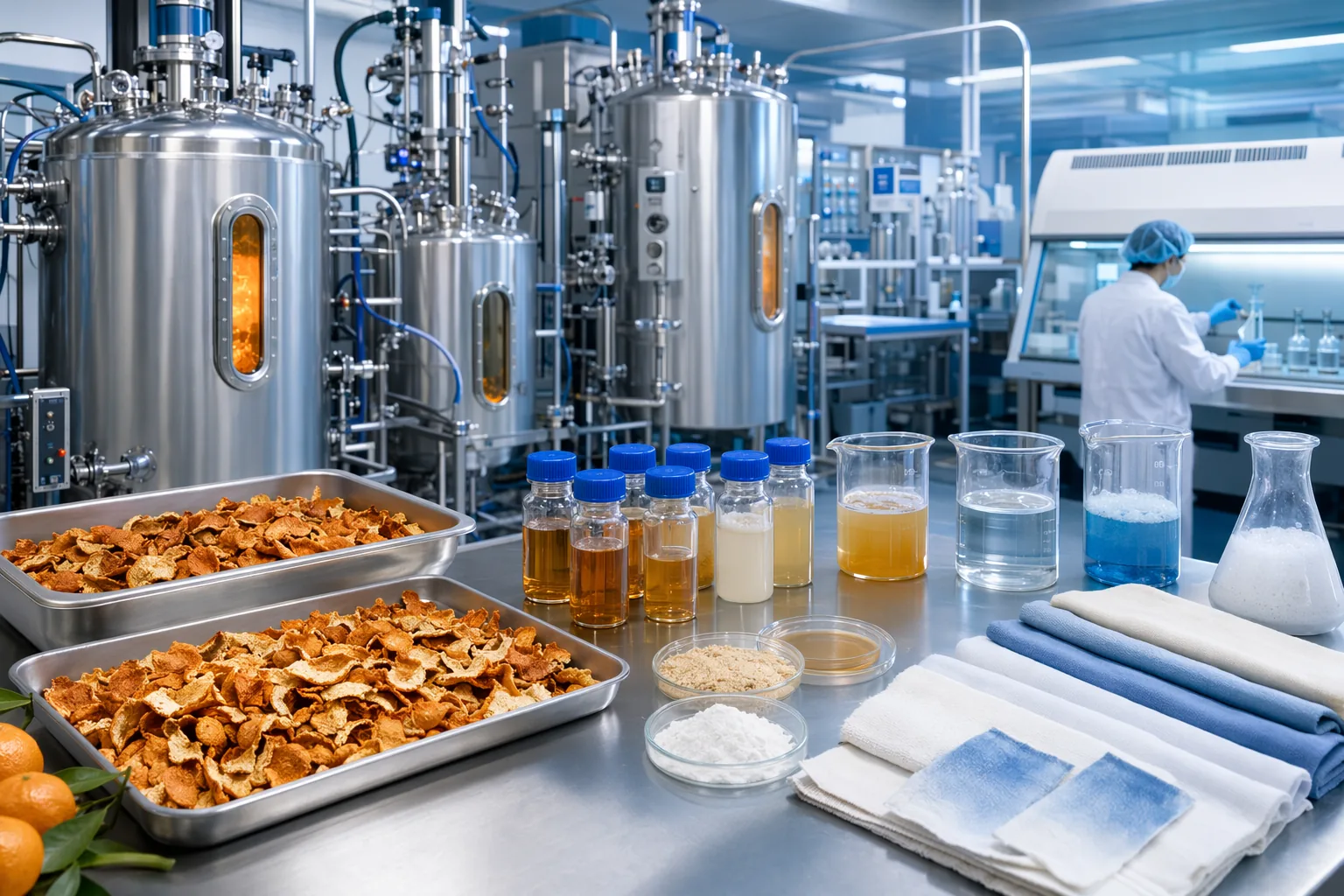
A practical B2B guide for detergent formulators evaluating mandarin peel as a fruit-based substrate for cold-active enzyme production and cold wash performance.
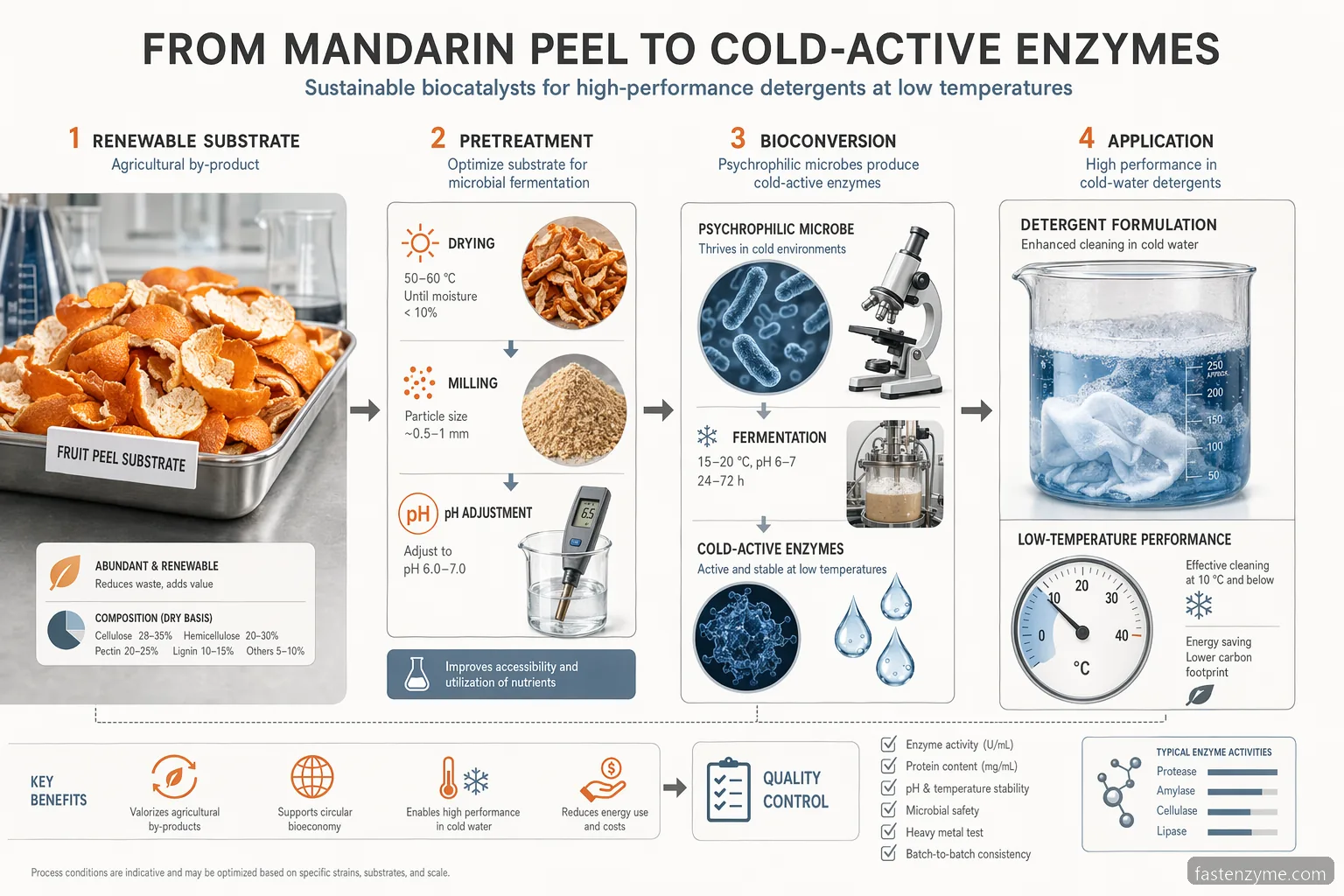
Why Mandarin Peel Is Considered for Cold-Active Enzyme Production
Mandarin peel is an agro-industrial fruit substrate rich in pectin, cellulose, hemicellulose, soluble sugars, and micronutrients. These components can support microbial growth and induce enzyme systems relevant to detergent development, especially pectinase, cellulase, amylase, protease, and lipase blends. For buyers searching for substrate with mandarin peel for production cold active enzymes, the business case is usually tied to raw material valorization, lower fermentation input cost, and a sustainability-oriented supply story. The technical case still depends on consistency. Peel composition changes with season, variety, juice-processing method, drying conditions, and residual essential oils. Limonene and other peel oils may inhibit some microorganisms, so pretreatment is often required. For cold water detergent applications, the final question is not whether a psychrophilic enzyme can be produced, but whether the enzyme preparation performs reliably in detergent matrices at low temperature.
Relevant to cold water detergent and energy-saving laundry formulations • Best evaluated as a controlled substrate, not as an undefined waste stream • Requires screening for inhibitors, moisture, ash, and microbial load
Recommended Substrate Preparation and Pretreatment
A practical substrate for production cold active enzymes starts with clean, traceable mandarin peel from food-processing streams. The peel is typically washed, size-reduced, and dried at moderate temperature to control microbial load without excessive nutrient damage. Milling to a consistent particle size improves mixing and substrate accessibility. For submerged fermentation, peel powder may be extracted or hydrolyzed into a nutrient liquor; for solid-state fermentation, moisture is adjusted to support growth while maintaining aeration. Typical starting moisture for solid-state systems may be 55-70%, while submerged media often use 1-5% dry peel solids, adjusted after lab screening. pH is commonly set between 5.0 and 7.5 for production screening, then optimized by organism and target enzyme. Essential oil reduction by washing, steam treatment, or controlled drying should be validated because peel oils can depress yield or alter enzyme profiles.
Control particle size, moisture, and peel oil content • Screen 1-5% dry solids in submerged fermentation • Evaluate 55-70% moisture for solid-state fermentation • Document peel source, storage time, and pretreatment lot data
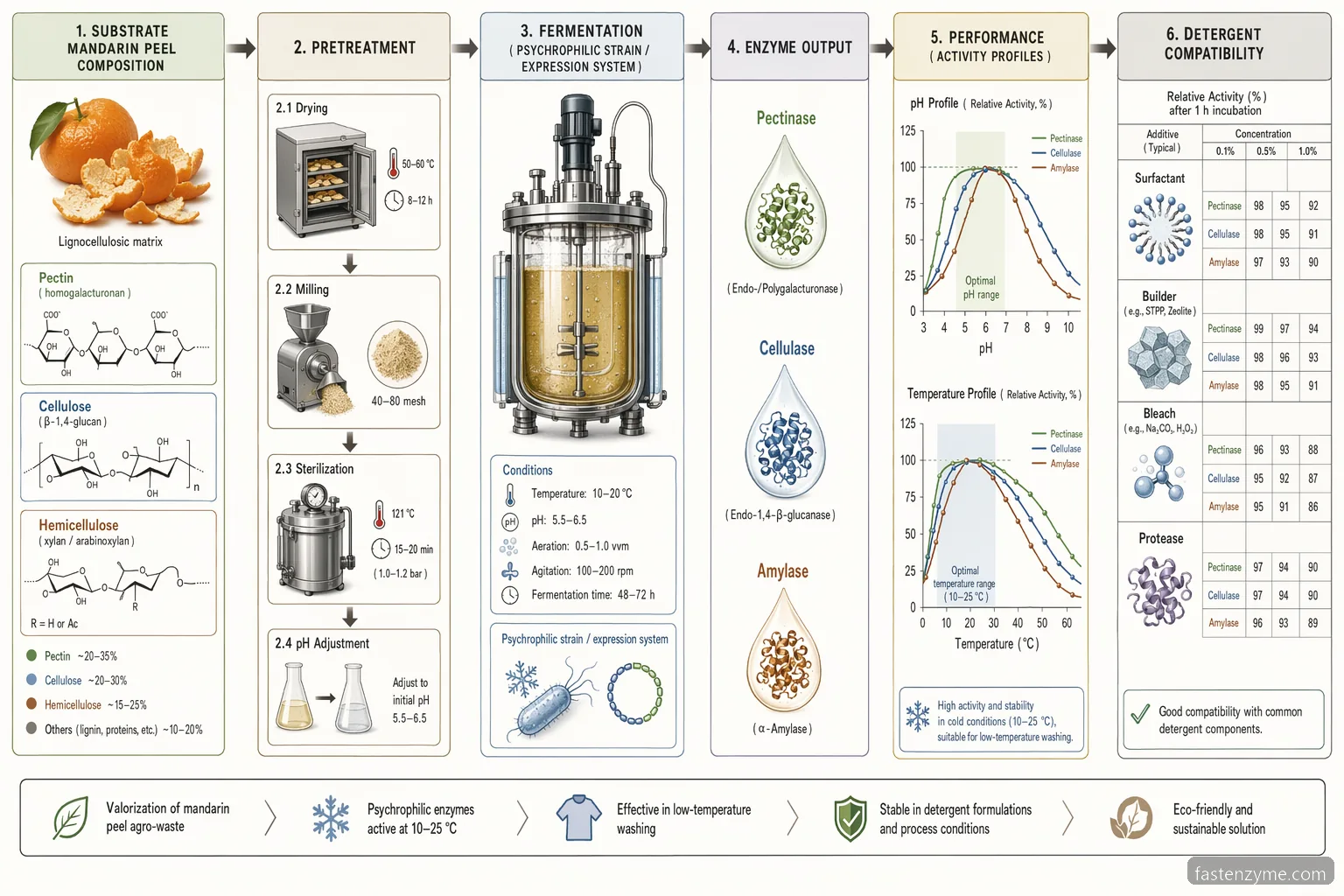
Microbial Routes: Psychrophilic Strains and Expression Systems
Cold-active enzymes may be obtained from naturally cold-adapted microorganisms, mesophilic producers screened for low-temperature activity, or recombinant expression systems. In early R&D, a substrate for production cold active multi enzymes may be paired with bacteria, fungi, or yeast selected for secreted enzyme output at 10-25°C. Some programs examine cold active enzymes with expression vector for Yamadazyma or other yeast hosts when secretion, glycosylation, or feedstock tolerance is important. Similar work may target amylase genes, including searches written as cold active enzymes with expression vector for amylse, though technical documents should standardize the term as amylase. For commercial detergent supply, the buyer should focus on strain traceability, production reproducibility, downstream purification level, residual host material controls, and regulatory suitability for industrial detergent use. The expression route is only valuable if it improves cost-in-use and wash performance.
Screen activity at 10°C, 20°C, and 30°C • Confirm secretion yield and downstream recoverability • Assess suitability for alkaline detergent systems • Request non-confidential strain and process control summaries
Process Conditions for Cold-Active Multi-Enzyme Complexes
A cold active enzymes complex with fruit substrate should be developed around target detergent performance, not only maximum fermentation activity. Production trials commonly explore 10-30°C incubation, pH 5.0-8.0 during production, and carbon-to-nitrogen balance using mandarin peel with supplemental nitrogen such as yeast extract, soybean meal, ammonium salts, or other permitted industrial nutrients. Protease and amylase expression may require different induction conditions than cellulase or pectinase, so a cold active multi enzyme complex with fruit substrate may be produced as a blended product from separate fermentations rather than one uncontrolled mixed broth. Downstream steps can include filtration, concentration, stabilization, granulation, or liquid formulation. Stabilizers should be selected for detergent compatibility and declared in the TDS. Before scale-up, run shake-flask, bench, and pilot fermentations to compare enzyme profile, batch yield, foam behavior, bioburden, and storage stability.
Typical production screening temperature: 10-30°C • Typical production pH screening range: 5.0-8.0 • Detergent application pH target often falls around pH 8-11 • Separate production may improve control of multi-enzyme ratios
Detergent Formulation Fit and Dosage Guidance
For cold wash detergent, enzyme selection should be based on stain panels and fabric-care targets. A cold wash detergent enzyme must retain useful activity in the presence of anionic and nonionic surfactants, builders, chelants, polymers, perfume components, preservatives, oxidants if present, and alkaline pH. Screening should include 10°C, 15°C, 20°C, and 30°C wash cycles, because a low temperature enzyme can show good lab activity yet underperform in a complete formulation. Initial dosage bands for liquid or powder detergents are often established by activity units rather than mass, then converted into finished-product dosage after supplier data review. As a practical starting range, formulators may screen 0.05-1.0% enzyme preparation in detergent prototypes, adjusting for activity concentration, enzyme type, and stability. Final dosage should be chosen by cost-in-use, cleaning benefit, fabric impact, and shelf-life retention.
Validate in the actual detergent base, not buffer only • Use standardized sebum, starch, protein, and particulate stains • Check stability after heat aging and freeze-thaw where relevant • Optimize by activity units and cost per wash
QC Checks, Documentation, and Supplier Qualification
Industrial buyers should qualify both the enzyme and the mandarin peel substrate process. At minimum, request a Certificate of Analysis, Technical Data Sheet, and Safety Data Sheet for each commercial lot or representative pilot lot. The COA should define activity units, method conditions, appearance, pH, moisture or solids, microbial limits where applicable, and batch number. The TDS should explain recommended storage, handling, dosage, compatibility, and stability. The SDS should address dust, aerosol, respiratory sensitization risk, personal protective equipment, and spill handling. For a substrate for cold active enzymes, ask how peel lots are controlled for moisture, pesticides or contaminants according to applicable feedstock policy, heavy metals where relevant, and inhibitory oils. Supplier qualification should include pilot validation, change-control expectations, traceability, lead time, packaging, sample retention, and a clear plan for troubleshooting activity drift.
Request COA, TDS, and SDS before pilot purchasing • Audit activity assay method and temperature conditions • Compare at least three pilot lots for consistency • Review cost-in-use rather than price per kilogram alone
Technical Buying Checklist
Buyer Questions
It can be reliable when treated as a controlled industrial raw material rather than a variable waste stream. Buyers should require defined peel origin, drying method, particle size, moisture, storage conditions, and checks for inhibitory peel oils. The substrate with mandarin peel for cold active enzymes must be validated across several lots to confirm enzyme yield, activity profile, and detergent performance consistency.
Request the COA, TDS, SDS, and the activity assay method, including temperature, pH, substrate, and unit definition. For pilot validation, ask for retained activity data in the target detergent base, microbial and physical specifications where applicable, storage guidance, and lot traceability. A useful supplier will also support stain-panel testing and cost-in-use calculations.
Sometimes, but it depends on the organism and process controls. A single fermentation may produce several activities, yet the ratio may shift between lots. For detergent manufacturing, controlled blending of separately produced protease, amylase, lipase, cellulase, or pectinase often gives more predictable performance than relying on an undefined cold active multi enzyme complex with fruit substrate.
Start with activity-based screening in the actual detergent formulation at 10-30°C. A common prototype range is about 0.05-1.0% enzyme preparation, but the correct level depends on activity concentration, enzyme type, formulation stability, target stains, and wash conditions. Final dosage should be based on cleaning gain per wash, retained shelf-life activity, and total cost-in-use.
They can be relevant in R&D if an expression host improves secretion, consistency, or economics. Programs may evaluate yeast hosts such as Yamadazyma or recombinant amylase systems, but commercial detergent buyers should not rely on the expression route alone. The decision should be based on documented performance, safety handling data, regulatory suitability for industrial detergents, and supply reliability.
Related Search Themes
substrate with mandarin peel for cold active enzymes, substrate for production cold active multi enzymes, substrate for production cold active enzymes, cold active enzymes complex with fruit substrate, substrate for cold active enzymes, cold active multi enzyme complex with fruit substrate
Cold-Active Detergent Enzymes for Research & Industry
Need Cold-Active Detergent Enzymes for your lab or production process?
ISO 9001 certified · Food-grade & research-grade · Ships to 80+ countries
Frequently Asked Questions
Is mandarin peel a reliable substrate for cold-active detergent enzymes?
It can be reliable when treated as a controlled industrial raw material rather than a variable waste stream. Buyers should require defined peel origin, drying method, particle size, moisture, storage conditions, and checks for inhibitory peel oils. The substrate with mandarin peel for cold active enzymes must be validated across several lots to confirm enzyme yield, activity profile, and detergent performance consistency.
What QC data should a buyer request before pilot trials?
Request the COA, TDS, SDS, and the activity assay method, including temperature, pH, substrate, and unit definition. For pilot validation, ask for retained activity data in the target detergent base, microbial and physical specifications where applicable, storage guidance, and lot traceability. A useful supplier will also support stain-panel testing and cost-in-use calculations.
Can one mandarin peel process produce a full cold-active multi-enzyme complex?
Sometimes, but it depends on the organism and process controls. A single fermentation may produce several activities, yet the ratio may shift between lots. For detergent manufacturing, controlled blending of separately produced protease, amylase, lipase, cellulase, or pectinase often gives more predictable performance than relying on an undefined cold active multi enzyme complex with fruit substrate.
How should dosage be selected for cold water detergent?
Start with activity-based screening in the actual detergent formulation at 10-30°C. A common prototype range is about 0.05-1.0% enzyme preparation, but the correct level depends on activity concentration, enzyme type, formulation stability, target stains, and wash conditions. Final dosage should be based on cleaning gain per wash, retained shelf-life activity, and total cost-in-use.
Are recombinant cold-active enzymes relevant to mandarin peel substrate programs?
They can be relevant in R&D if an expression host improves secretion, consistency, or economics. Programs may evaluate yeast hosts such as Yamadazyma or recombinant amylase systems, but commercial detergent buyers should not rely on the expression route alone. The decision should be based on documented performance, safety handling data, regulatory suitability for industrial detergents, and supply reliability.
Related: Cold-Active Detergent Enzymes for Low-Temperature Cleaning
Turn This Guide Into a Supplier Brief Ask Fast Enzyme for cold-wash enzyme samples, COA/TDS/SDS, and pilot support for mandarin peel substrate validation. See our application page for Cold-Active Detergent Enzymes for Low-Temperature Cleaning at /applications/cold-temperature-enzyme-activity/ for specs, MOQ, and a free 50 g sample.
Contact Us to Contributehello@mail.fastenzyme.com